Flood Barriers for Homes: Cost, Limits & the NFIP Catch (2026)
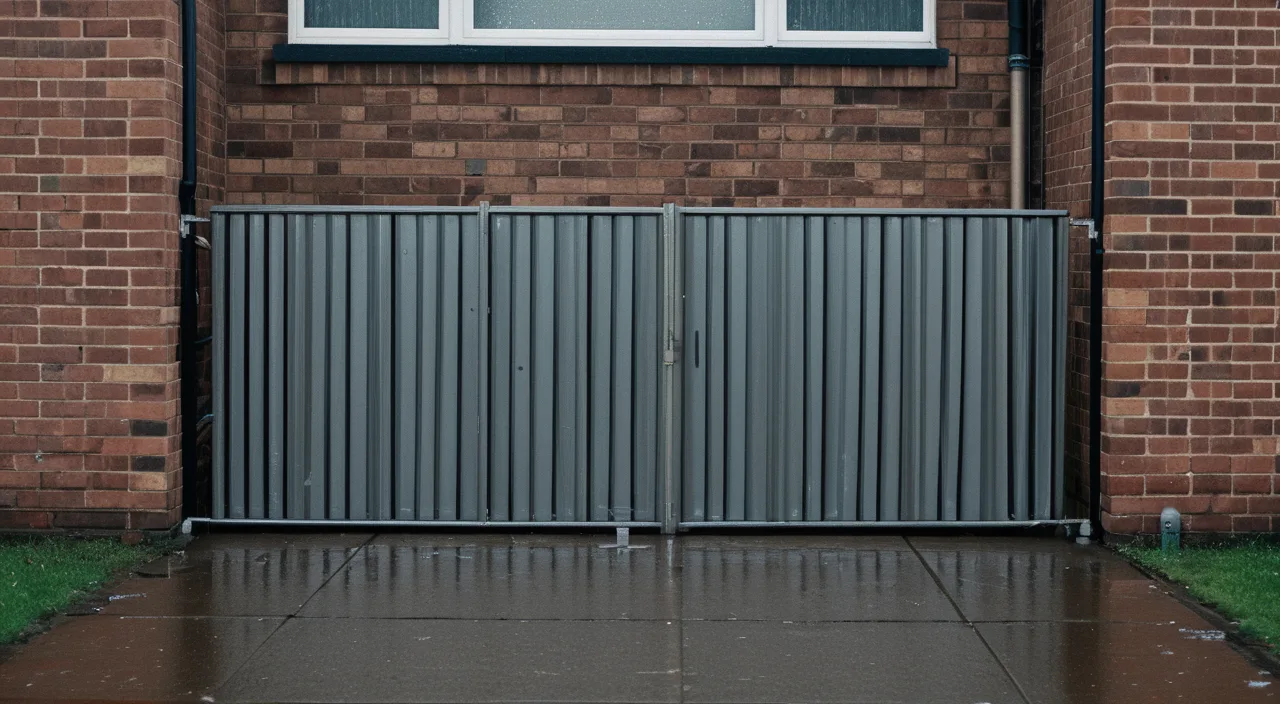
Deployable flood barriers run from a few hundred dollars for a single door shield to tens of thousands for a perimeter system, and every serious quote is site-specific. They are fast, removable protection against shallow, short-duration water. What they are not, and vendors rarely volunteer this, is an NFIP compliance path for a home: sealing a building against water (dry floodproofing) satisfies NFIP rules for non-residential buildings, and the rare residential exception requires a basement that stays watertight without human intervention.
What counts as a flood barrier
The category covers everything that blocks water at an opening or around a structure without changing the structure itself: door and garage dams, sectional aluminum or composite shields that drop into tracks, water-filled tubes and free-standing segments that ring part of a yard, and sandbag substitutes in polymer or gel. All share the same logic, deploy before the water, remove after, and the same dependencies: someone must be home to deploy them, and they hold back inches to a few feet of water for hours, not days.
What they cost, honestly framed
This is one place where this site will not print a tidy national table, because one does not credibly exist. The honest ranges:
- Single-opening shields (door dam, garage panel): from a few hundred dollars per opening, rising with width and rated depth.
- Multi-opening kits for a typical house: commonly low thousands, scaling with the number and size of openings.
- Perimeter and free-standing systems: into the tens of thousands, engineered and quoted per site.
Treat any single advertised number as a starting point for a conversation, not a price. Barrier vendors quote per application: openings, water depth, deployment time, storage. Compare that quote against the permanent measures on this site before signing, because at the multi-thousand level you enter vent retrofit and valve-and-pump territory, which work while you are asleep or away.
The NFIP catch every homeowner should hear first
Keeping water out of a building is dry floodproofing, and under NFIP rules dry floodproofing achieves compliance for non-residential structures, not homes. The one residential exception is narrow: in the 53 communities FEMA has granted a residential basement exception, a basement may sit below the Base Flood Elevation if it is engineered and certified to stay watertight without human intervention, which rules out anything you have to put in place by hand. Everywhere else, a home in a Special Flood Hazard Area cannot become NFIP-compliant by sealing and shielding; the residential paths are elevation, wet floodproofing with proper openings, or relocation. The practical consequences: barriers will not bring a non-compliant home into compliance, will not by themselves earn the structural rating credits that lower an NFIP premium, and generally sit outside what FEMA mitigation grants fund for residences. Barriers are damage reduction, real and worth having, not regulatory or insurance progress.
Where barriers genuinely earn their money
Short, shallow, predictable flooding is their home turf: street flash-flooding that puts inches against the door a few times a year, garage and basement entries below grade, businesses protecting storefronts (where dry floodproofing is also the compliant route). One inch of water inside a home can do up to $25,000 of damage (NRDC/FEMA figures), so a few hundred dollars of door dam that keeps one event outside has a defensible payback. For repeated or deeper flooding, run the numbers on permanent measures with the payback estimator, grant cost-share at 75–100% changes the comparison dramatically in favor of the permanent fix.
The honest checklist before buying
- Measure the real threat: depth, duration, warning time. Barriers suit inches-with-warning, not feet-without.
- Count every opening water can reach, including vents and utility penetrations; a sealed front door beside an open weep hole is theater.
- Ask the vendor for the rated water depth and the deployment time, in writing.
- Price the permanent alternative for the same money before committing at the multi-thousand level.
- Remember the rule above: for a residence, barriers reduce damage; they do not create compliance or rating credits.
Frequently asked
How much do flood barriers for homes cost?
Do flood barriers lower flood insurance?
Are flood barriers better than sandbags?
Can flood barriers protect against deep flooding?
Will FEMA grants pay for flood barriers?
Estimate your real number
Run your mitigation cost, current premium and flood-risk status through the Payback Estimator: net cost after grants, lower insurance, and the payback in years.